
When two effects act together (like wind + river current), the final motion is not found by simple addition. We use vector addition to find the resultant (final speed and direction).
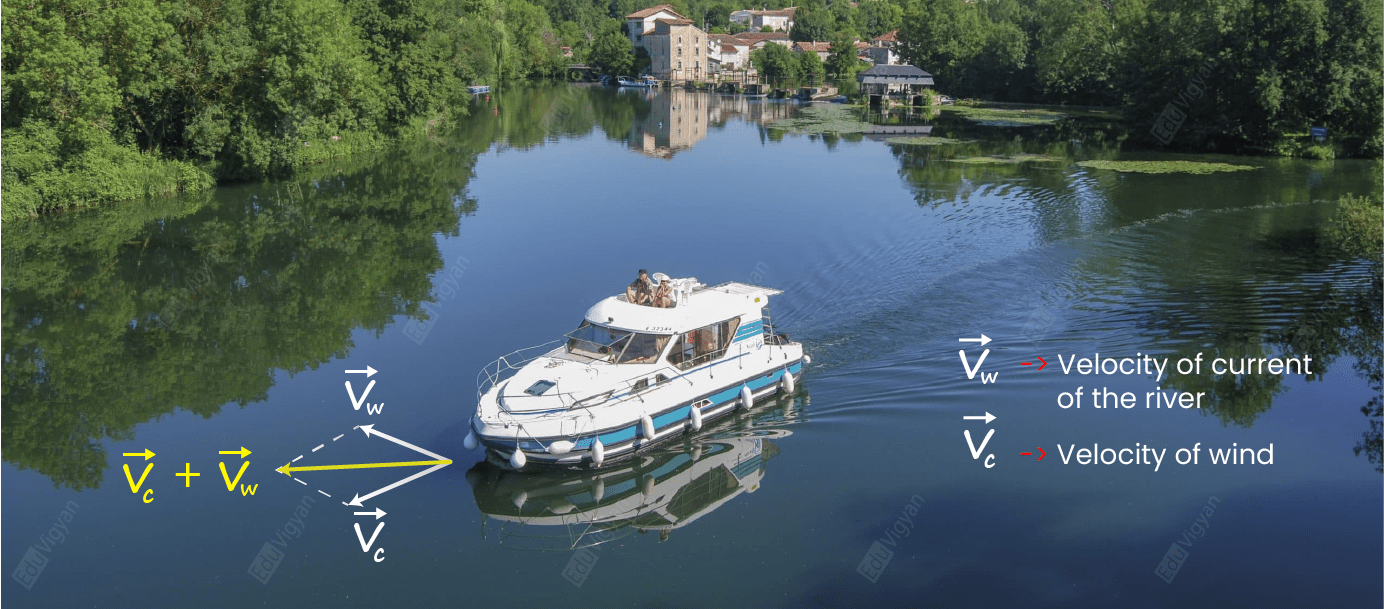
Boat–Wind–Current Story (Motivation)
Imagine you are sailing a boat in a river:
- Wind pushes the boat in one direction.
- Water current pushes your boat in another direction.
These two effects act together at an angle. So the natural questions are:
- Where will you end up?
- What will be the final direction?
- What will be the final speed?
Triangle Rule of Vector Addition (Concept)
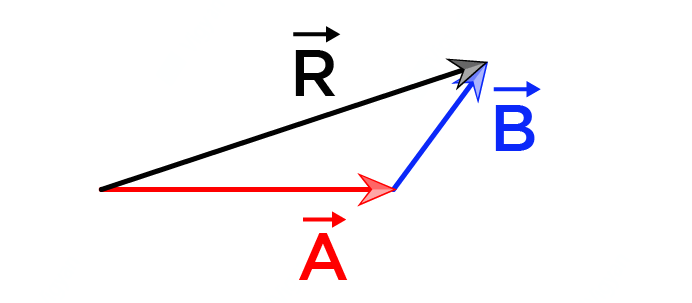
Suppose we have two vectors A and B, with an angle θ between them. We want their resultant vector R.
Step-by-step (Tip-to-tail)
- Draw vector A.
- From the tip (head) of A, draw vector B.
- The vector from the tail of A to the tip of B is the resultant R.
Resultant Magnitude (Derivation: clean & slow)
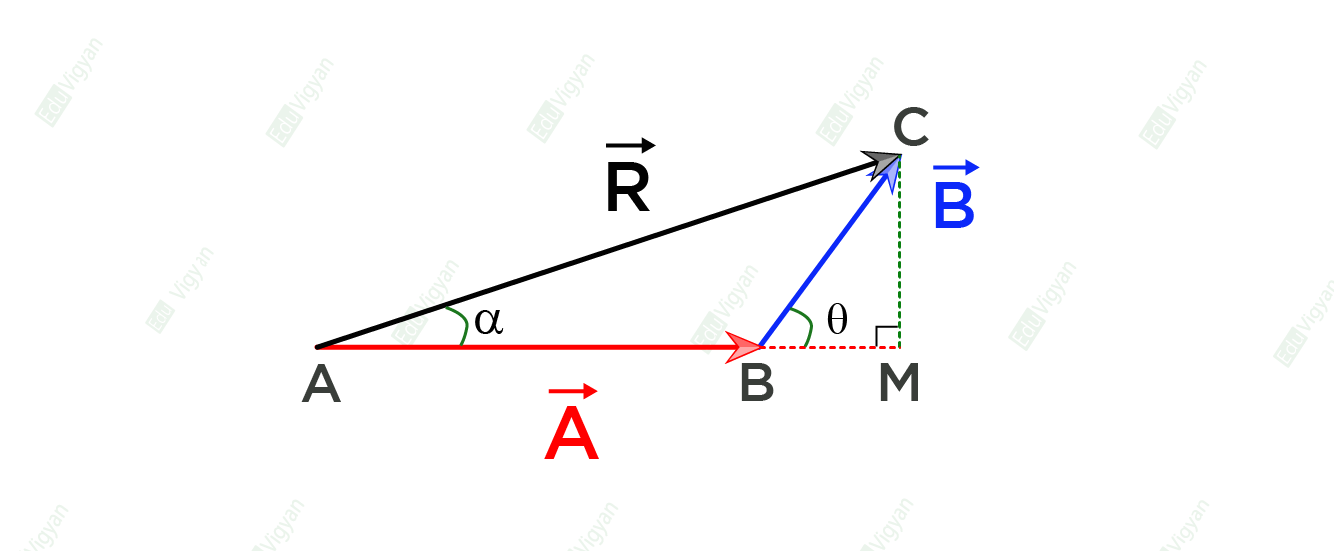
Consider the triangle formed by vector addition:
- AB = A
- BC = B
- AC = R (resultant)
Drop a perpendicular from point C to the line AB meeting at M. Then:
Quick Understanding (Special Angles)
| Angle between A and B | cosθ | Resultant magnitude | Meaning |
|---|---|---|---|
| θ = 0° | 1 | R = A + B | Same direction → maximum resultant |
| θ = 90° | 0 | R = √(A² + B²) | Perpendicular → Pythagoras |
| θ = 180° | -1 | R = |A − B| | Opposite direction → subtraction |
Resultant Direction (Angle α)
Let α be the angle between the resultant R and vector A. From the same right-triangle:
More Important Ideas in Addition of Vectors
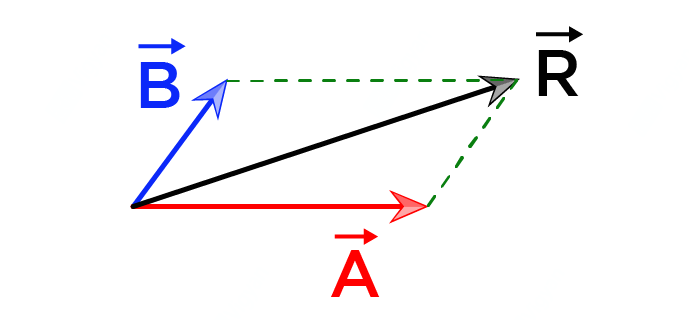
1) Parallelogram Law
If two vectors start from the same point, draw them as adjacent sides of a parallelogram. The diagonal from the starting point gives the resultant.
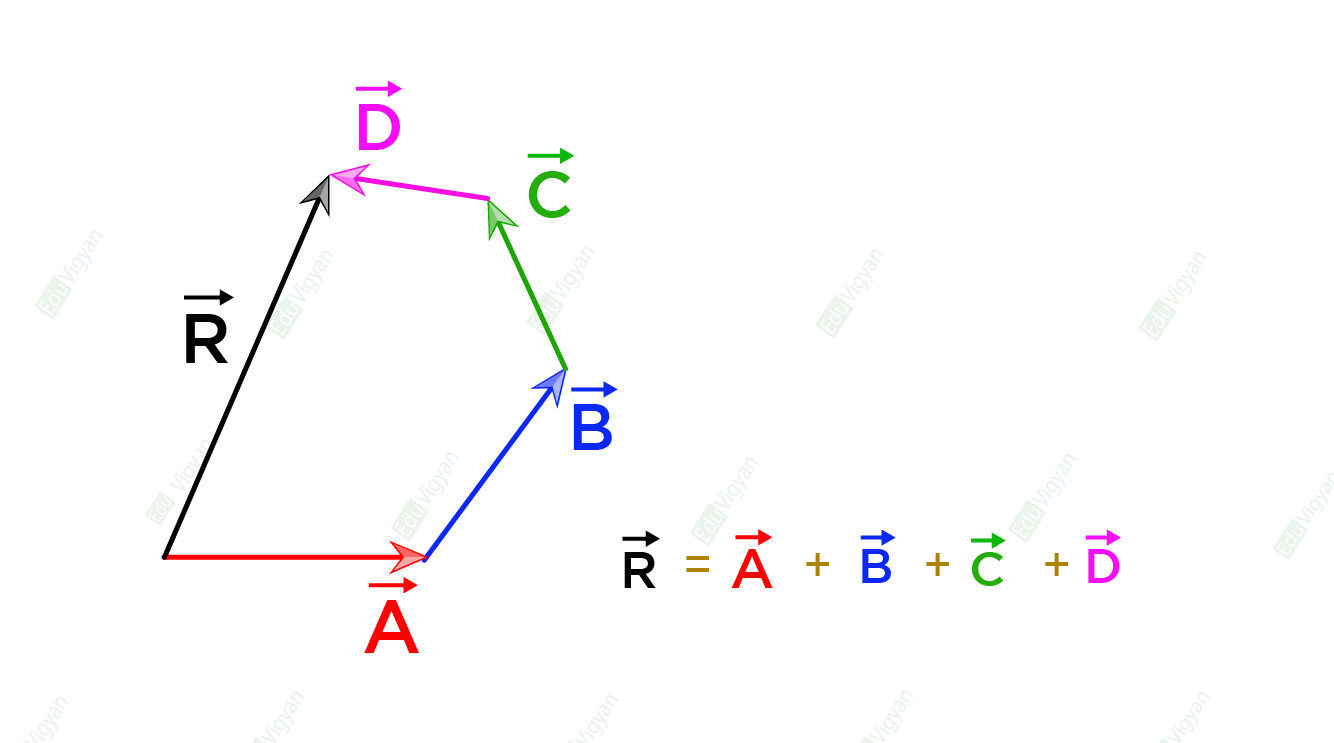
2) Head-to-tail method for many vectors
For adding 3 or more vectors, place them head-to-tail in sequence. The resultant connects the start of the first to the end of the last.
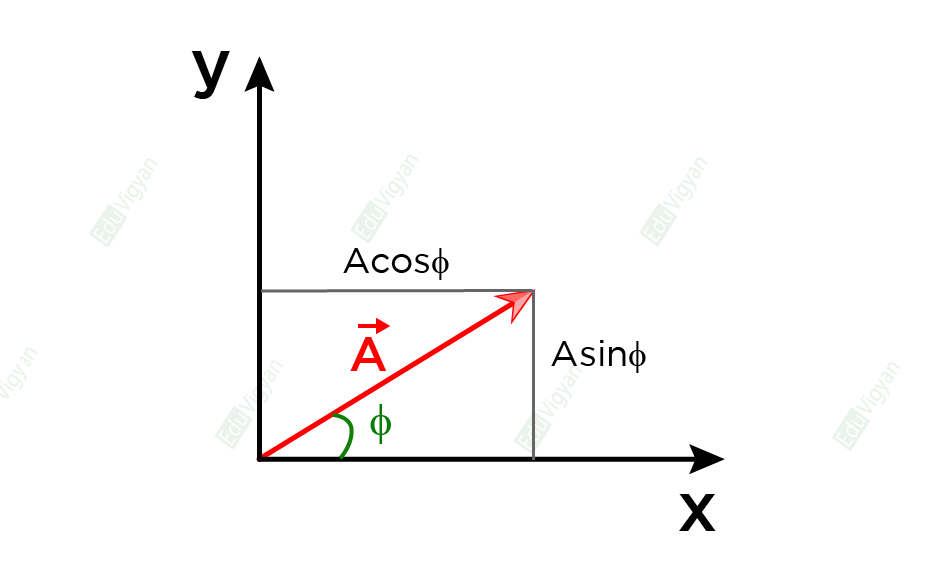
3) Components method (powerful alternative)
If a vector makes an angle φ with the x-axis, then:
Solved Numerical Examples
A boat moves at 4 m/s due to wind towards east, and the river current flows at 3 m/s towards north. Find the resultant speed and direction.
Here A = 4 (east), B = 3 (north), and θ = 90°.
Resultant speed = 5 m/s, direction = 36.9° north of east.
Two forces of 10 N and 6 N act at an angle of 60°. Find the magnitude of the resultant force.
Resultant force magnitude = 14 N.
Two vectors 18 N east and 11 N west act on a body. Find the resultant (magnitude + direction).
Resultant = 7 N towards east.
Two vectors have magnitudes A = 8 units and B = 5 units with angle θ = 53° between them. Find (i) resultant magnitude and (ii) angle α with vector A. (Use cos53≈0.6, sin53≈0.8)
Resultant ≈ 11.7 units, direction ≈ 20° from A towards B.
Practice Questions (For Students)
A) Conceptual Questions
- State the triangle rule of vector addition in your own words.
- Why can’t we add magnitudes directly when vectors are at an angle?
- What is the difference between the triangle rule and the parallelogram law?
- For which angle between vectors is the resultant maximum? For which is it minimum?
- If A + B = 0, what must be true about A and B?
B) Numerical Questions
- Two vectors of magnitudes 9 and 12 act at 90°. Find the resultant magnitude.
- A boat has speed 6 m/s towards east. River current is 8 m/s towards north. Find resultant speed and direction.
- Two forces 15 N and 10 N act at an angle of 120°. Find the magnitude of resultant force.
- Two displacements 20 m and 15 m act at 60°. Find the magnitude of resultant displacement.
- Using components: A = 10 units at 0° and B = 10 units at 90°. Find R and its angle with +x axis.
- Two vectors 7 units and 9 units act at 30°. Find the resultant magnitude (use cos30 = 0.866).
Answers (Click to reveal)
Summary (Takeaway)
- Vector addition finds the resultant of two or more vectors.
- Triangle rule (tip-to-tail) gives both magnitude and direction of the resultant.
- For two vectors at angle θ:
R = √(A² + B² + 2AB cosθ) α = tan⁻¹( (B sinθ) / (A + B cosθ) )
- Special angles (0°, 90°, 180°) help you quickly understand max/min cases.
- For multiple vectors, the components method is the most powerful tool.