
We live in a three-dimensional world. So when an object moves, its direction can change in three independent ways: along x, along y, and along z. To handle such motion neatly, physics uses unit vectors and the resolution of vectors.
What is a Unit Vector?
A unit vector is a vector whose magnitude is exactly 1. Its job is to show direction only. That’s why unit vectors are like “compass arrows”: they tell you the direction but not the distance.
Standard unit vectors in 3D
In a Cartesian (x–y–z) coordinate system, we use three mutually perpendicular unit vectors:
How to Create a Unit Vector from Any Vector (Derivation)
Suppose you have a vector \(\vec{A}\) (not necessarily a unit vector). The unit vector along the direction of \(\vec{A}\) is written as \(\hat{A}\).
Why does this work?
Dividing a vector by its magnitude keeps the direction same but scales the length to 1.
Resolution of a Vector in 3D (Main Idea)
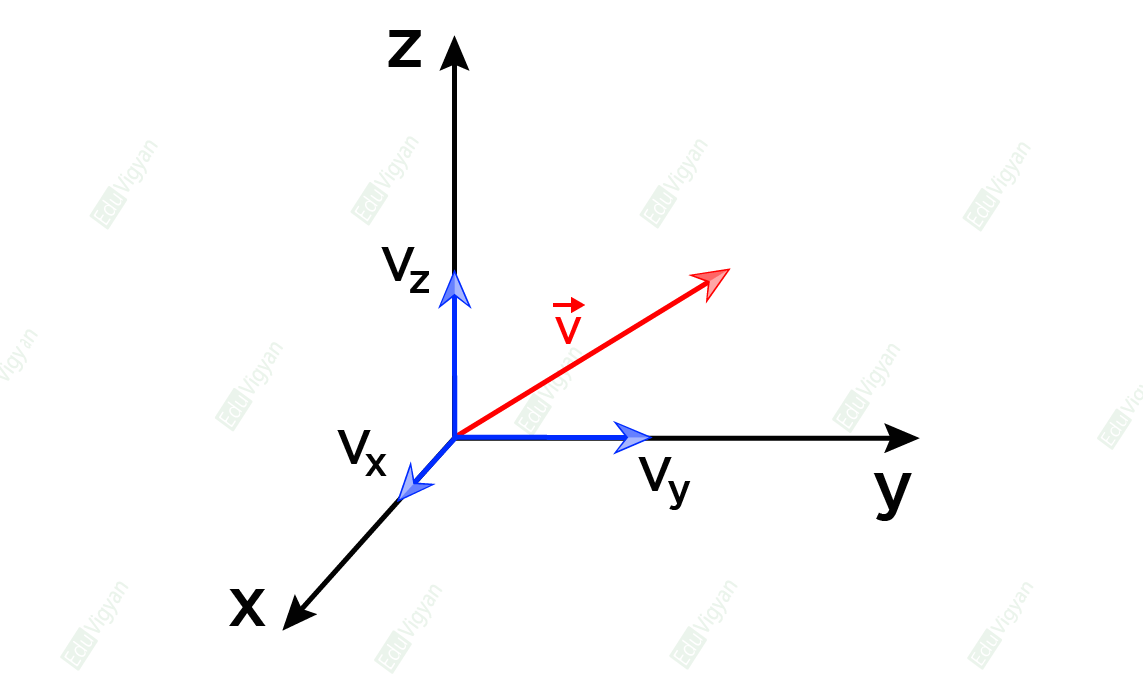
Consider a vector \(\vec{V}\) pointing in any direction in space. We can “break” it into three perpendicular components:
- \(V_x\) along x-axis
- \(V_y\) along y-axis
- \(V_z\) along z-axis
Then the vector can be written using unit vectors as:
Magnitude of a Vector in Component Form (Derivation)
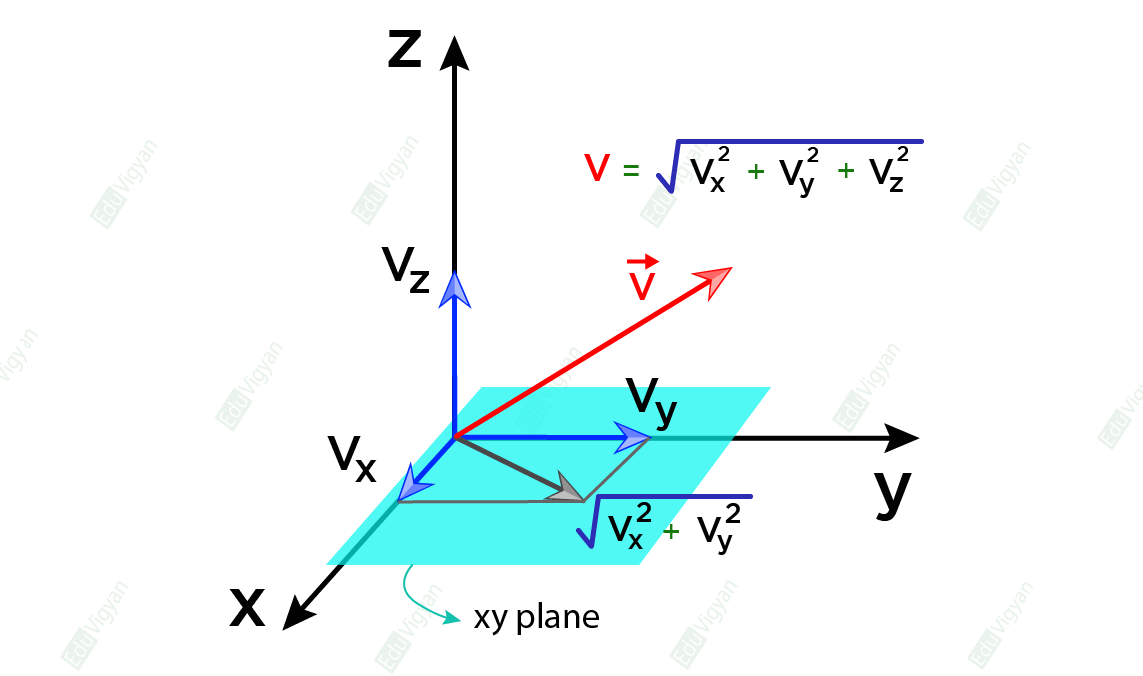
If \(\vec{V}=V_x\hat{i}+V_y\hat{j}+V_z\hat{k}\), then the magnitude of \(\vec{V}\) is given by 3D Pythagoras:
Why?
Because \(V_x, V_y, V_z\) are perpendicular components. First combine \(V_x\) and \(V_y\) in the xy-plane, then include \(V_z\).
Direction Cosines and Direction Angles (Important Derivation)
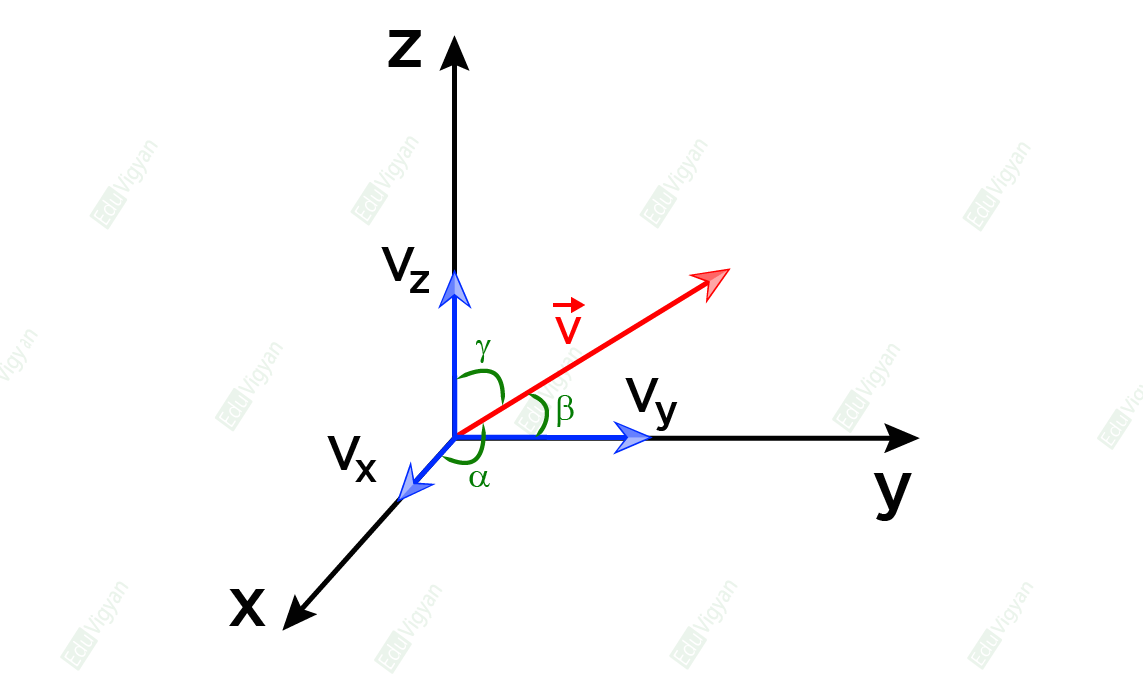
Let \(\vec{V}\) make angles \(\alpha\) with x-axis, \(\beta\) with y-axis, and \(\gamma\) with z-axis. Then:
Direction cosine identity (must-know)
Square and add the three equations:
Unit Vector Along a Given Vector in 3D (With Components)
If \(\vec{V}=a_x\hat{i}+a_y\hat{j}+a_z\hat{k}\), then:
Solved Numerical Examples
A vector is \(\vec{V}=3\hat{i}+4\hat{j}+12\hat{k}\). Find its magnitude.
So, the magnitude is 13 units.
Find the unit vector along \(\vec{A}=2\hat{i}-2\hat{j}+1\hat{k}\).
A vector has magnitude 20 and makes angles \(\alpha=60^\circ\), \(\beta=45^\circ\) with x and y axes. Find \(V_x\) and \(V_y\). (Use \(\cos60^\circ=0.5\), \(\cos45^\circ=0.707\))
(To find \(V_z\), you would need \(\gamma\) or use the identity if enough information is given.)
For \(\vec{V}=6\hat{i}+2\hat{j}+3\hat{k}\), find \(\cos\alpha,\cos\beta,\cos\gamma\).
Check: \((6/7)^2+(2/7)^2+(3/7)^2=(36+4+9)/49=1\) ✅
Practice Questions (For Students)
A) Conceptual
- What is a unit vector? Why is its magnitude always 1?
- Why do we use \(\hat{i},\hat{j},\hat{k}\) to describe vectors?
- What do direction cosines represent physically?
- Write the identity involving \(\cos\alpha,\cos\beta,\cos\gamma\). Why is it useful?
- Can two different vectors have the same unit vector? Explain.
B) Numerical
- Find \(|\vec{A}|\) if \(\vec{A}=5\hat{i}-12\hat{j}+0\hat{k}\).
- Find the unit vector along \(\vec{B}=4\hat{i}+0\hat{j}-3\hat{k}\).
- If \(|\vec{V}|=50\) and \(\cos\alpha=0.6\), find \(V_x\).
- For \(\vec{V}=2\hat{i}+3\hat{j}+6\hat{k}\), find \(\cos\gamma\).
- A vector has direction cosines \((0.2,0.8,k)\). Find \(k\).
- A drone’s velocity is \(\vec{V}=12\hat{i}+5\hat{j}+9\hat{k}\ \text{m/s}\). Find its speed.
Answers (Click to reveal)
Summary (Takeaway)
- Unit vectors \(\hat{i},\hat{j},\hat{k}\) give standard directions along x, y, z axes.
- Any vector in 3D can be written as \(\vec{V}=V_x\hat{i}+V_y\hat{j}+V_z\hat{k}\).
- Magnitude: \( |\vec{V}|=\sqrt{V_x^2+V_y^2+V_z^2} \)
- Direction cosines:
$$\cos\alpha=\frac{V_x}{|\vec{V}|},\quad \cos\beta=\frac{V_y}{|\vec{V}|},\quad \cos\gamma=\frac{V_z}{|\vec{V}|}$$ $$\cos^2\alpha+\cos^2\beta+\cos^2\gamma=1$$
- Unit vector along \(\vec{V}\): \(\hat{V}=\vec{V}/|\vec{V}|\)